




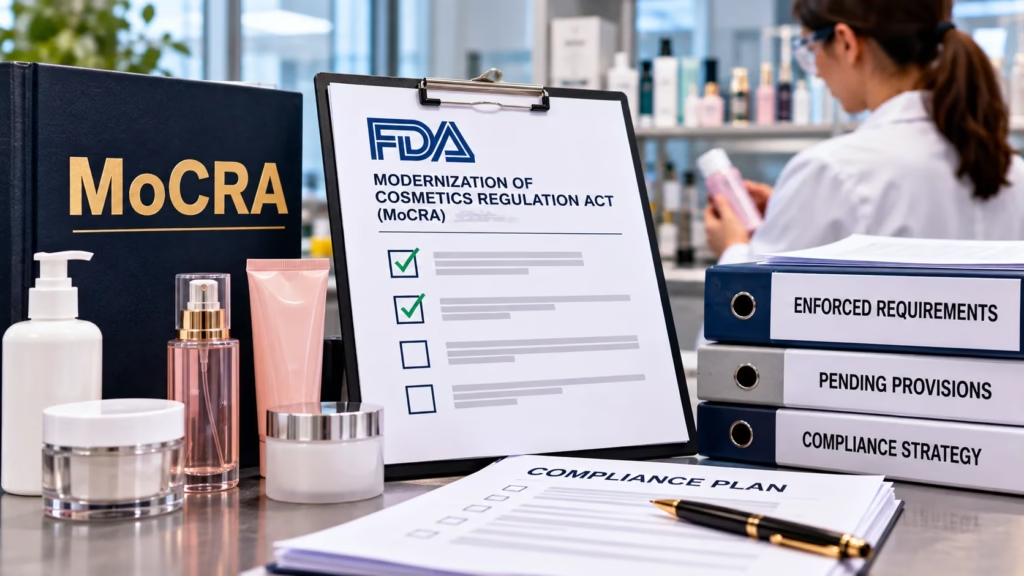
MoCRA in 2026: What Is Enforced and What Is Still Pending
The Modernization of Cosmetics Regulation Act of 2022 (MoCRA) significantly changed the regulatory landscape for cosmetics in the United States.
Unlike the previous framework, MoCRA introduced mandatory requirements for cosmetic companies in areas such as facility registration, product listing, serious adverse event reporting, safety substantiation, and access to certain records.
By 2026, many of these requirements are already part of the FDA compliance landscape. At the same time, several MoCRA provisions still depend on FDA rulemaking, guidance, or further implementation.
For cosmetic manufacturers, processors, brands, importers, and responsible persons, the key question is no longer simply what MoCRA requires.
It is:
What must companies comply with today, and what should they be preparing for next?
What Is MoCRA?
MoCRA, enacted on December 29, 2022, is the most significant expansion of FDA’s authority over cosmetics in decades.
The law amended the Federal Food, Drug, and Cosmetic Act and created new requirements and authorities covering:
- Cosmetic facility registration
- Cosmetic product listing
- Serious adverse event reporting
- Safety substantiation
- Records access
- Mandatory recall authority
- Good Manufacturing Practices
- Fragrance allergen labeling
- Talc and asbestos testing requirements
Some of these provisions are already mandatory, while others require FDA to establish regulations or additional guidance before their implementation is complete.
MoCRA Requirements That Are Already Enforced
1. Cosmetic Facility Registration
Facility registration is one of the most important MoCRA requirements already in effect.
Manufacturers and processors of cosmetic products generally must register their facilities with FDA and renew those registrations every two years, subject to applicable exemptions.
FDA’s Cosmetics Direct system is currently being used for facility registration and renewal.
In February 2026, FDA updated Cosmetics Direct to display facility registration status and renewal dates and added automated reminders for registered facilities.
Companies should therefore maintain an accurate record of:
- Facility information
- Ownership information
- U.S. agent information, when applicable
- Contact information
- Registration status
- Renewal date
A facility registration is not an FDA approval or certification of the facility or its products.
FDA specifically states that it does not issue certificates verifying cosmetic facility registration.
2. Cosmetic Product Listing
Responsible persons are required to list marketed cosmetic products with FDA.
The listing includes information such as the product name and applicable ingredient information, and updates are required annually.
Companies should have an internal process to ensure that new products, discontinued products, formulation changes, and other changes affecting product listings are properly evaluated.
As of June 30, 2026, FDA reported more than 1.29 million active cosmetic product listings and more than 16,000 active registered cosmetic product facilities under MoCRA.
This demonstrates the scale at which the new registration and listing framework is operating.
3. Serious Adverse Event Reporting
Serious adverse event reporting is a mandatory MoCRA requirement.
A responsible person must report a serious adverse event associated with the use of a cosmetic product in the United States to FDA within 15 business days.
The report must include a copy of the product label or the label found on or within the retail packaging. If additional medical or other information is received within one year after the initial report, that information must also be submitted to FDA within 15 business days.
Companies should therefore have a written adverse-event procedure that establishes:
- Who receives complaints
- How complaints are evaluated
- How serious adverse events are identified
- Who determines whether FDA reporting is required
- How the 15-business-day deadline is tracked
- How supporting records are maintained
- How follow-up information is handled
This is an area where a delayed internal escalation process can create regulatory risk.
4. Safety Substantiation
MoCRA requires responsible persons to ensure that there is adequate substantiation of the safety of cosmetic products.
Companies must maintain records supporting the safety substantiation of their products.
Importantly, FDA does not prescribe one universal test or testing program that every cosmetic product must undergo.
FDA states that companies can use relevant safety data that is already available and that animal testing is not required simply to market a cosmetic product. The safety information supporting the product should nevertheless be scientifically robust and appropriate for the product and its ingredients.
Companies should maintain a documented safety substantiation file that can explain:
- Product identity
- Ingredient safety information
- Intended use
- Exposure considerations
- Relevant toxicological information
- Scientific literature
- Safety assessments
- Any other information supporting the safety conclusion
5. FDA Records Access
MoCRA expanded FDA’s authority to access certain cosmetic-related records.
FDA issued draft guidance in January 2026 addressing its records access authority for cosmetics products. The guidance explains FDA’s authority to access and copy certain records related to cosmetic products.
This makes record organization increasingly important.
Companies should be able to retrieve relevant records efficiently, particularly records related to:
- Serious adverse events
- Product safety
- Manufacturing
- Distribution
- Complaints
- Quality issues
- Recalls
- Investigations
The goal should be to maintain records so that the company can demonstrate control rather than searching for critical information only after FDA requests it.
6. FDA’s Mandatory Recall Authority
MoCRA also gives FDA authority to order a mandatory recall when statutory conditions are met.
This represents an important change from the historical cosmetics framework.
Companies should therefore have a documented recall and withdrawal process capable of supporting rapid decision-making if a product presents a serious health risk.
A recall procedure should address:
- Decision-making authority
- Product identification
- Lot/batch traceability
- Distribution records
- Customer notification
- Regulatory communication
- Effectiveness checks
- Product disposition
- Documentation
What Is Still Pending or Being Implemented?
Not every MoCRA provision has reached the same stage of implementation.
Several areas remain subject to FDA rulemaking, guidance development, or further regulatory action.
1. Cosmetic Good Manufacturing Practices
MoCRA requires FDA to establish Good Manufacturing Practice requirements for cosmetic products.
FDA has been working toward this requirement and has issued draft materials and conducted stakeholder engagement concerning cosmetic GMPs.
For companies, this is one of the most important pending areas.
Manufacturers should not wait for the final GMP framework before strengthening their quality systems.
Companies should already evaluate:
- Facility sanitation
- Equipment maintenance
- Personnel hygiene
- Raw material controls
- Production controls
- Packaging and labeling controls
- Batch records
- Specifications
- Quality control
- Complaint handling
- Deviation investigations
- CAPA
- Recordkeeping
The objective is to build a system capable of adapting when final cosmetic GMP requirements are established.
2. Fragrance Allergen Labeling
MoCRA requires FDA to establish fragrance allergen labeling requirements for cosmetic products.
The final regulatory framework is still an area requiring FDA action.
Companies that use fragrance ingredients should therefore maintain good visibility into fragrance composition and supplier information.
This can help reduce the amount of work required if additional labeling obligations become applicable.
Companies should consider maintaining:
- Fragrance composition information
- Supplier documentation
- Allergen information
- Product formulations
- Labeling assessments
- Change-control records
3. Talc and Asbestos Testing Requirements
MoCRA directs FDA to establish standardized testing methods for detecting and identifying asbestos in talc-containing cosmetic products.
FDA previously proposed testing methods in 2024 but withdrew that proposed rule in November 2025 after considering comments and determining that additional assessment was warranted.
FDA continues to evaluate the scientific and regulatory issues surrounding talc and asbestos.
This means companies using talc should not assume that the withdrawn proposed testing rule is currently a final requirement.
However, talc-containing cosmetic products remain an area that deserves careful attention.
Companies should consider evaluating:
- Supplier qualification
- Raw material specifications
- Certificates of analysis
- Testing practices
- Supplier controls
- Risk assessments
- Product-specific safety information
FDA has also continued testing talc-containing cosmetic products for asbestos contamination.
MoCRA: Enforced vs. Pending
A practical way to look at the 2026 landscape is:
| Area | 2026 Status |
|---|---|
| Facility registration | In effect |
| Facility renewal | In effect |
| Product listing | In effect |
| Annual product listing updates | In effect |
| Serious adverse event reporting | In effect |
| Safety substantiation | In effect |
| Records access authority | In effect |
| FDA mandatory recall authority | In effect |
| Cosmetic GMP regulations | Rulemaking/implementation ongoing |
| Fragrance allergen labeling regulations | Pending FDA regulatory action |
| Standardized talc/asbestos testing requirements | Pending; prior proposed rule withdrawn |
Companies should distinguish between requirements that are already legally applicable and provisions where FDA is still developing the implementing framework.
What Cosmetic Companies Should Be Doing in 2026
The best approach is not to wait for every remaining MoCRA regulation to become final.
Companies should first make sure the requirements that are already effective are fully implemented.
Step 1: Verify Facility Registration
Confirm that every applicable facility is properly registered.
Review:
- Facility information
- Registration status
- Renewal date
- U.S. agent information
- Ownership information
Step 2: Audit Your Product Listings
Create an internal inventory of marketed cosmetic products and compare it against your FDA product listings.
Look for:
- Missing products
- Discontinued products
- Formulation changes
- Ingredient changes
- Incorrect information
- Products requiring updates
Step 3: Strengthen Adverse Event Procedures
Test whether your company can identify and report a serious adverse event within the required 15-business-day period.
The procedure should clearly identify responsibilities and escalation timelines.
Step 4: Build a Safety Substantiation File
Each cosmetic product should have appropriate documentation supporting its safety.
Do not rely solely on supplier statements.
Evaluate whether the available scientific information actually supports the safety of the finished product under its intended conditions of use.
Step 5: Prepare for Cosmetic GMP
Even before final GMP regulations are established, companies can strengthen the fundamental controls expected of a well-managed manufacturing operation.
Focus on:
People → Facilities → Materials → Equipment → Production → Quality Control → Documentation → Complaints → CAPA
Step 6: Review Your Records System
Make sure records can be retrieved quickly.
A company should know where its:
- Formulas
- Specifications
- Batch records
- Testing records
- Complaint records
- Adverse event records
- Supplier records
- Safety substantiation
- Distribution records
are maintained.
Step 7: Monitor Pending MoCRA Requirements
Assign responsibility for monitoring FDA developments relating to:
- Cosmetic GMP
- Fragrance allergen labeling
- Talc and asbestos testing
- FDA guidance
- Additional implementation activity
A regulatory change-management process can prevent companies from discovering new obligations after a requirement has already become applicable.
Common MoCRA Compliance Mistakes
Several mistakes can create unnecessary regulatory risk.
Treating Registration as FDA Approval
FDA registration or product listing does not mean FDA has approved a cosmetic facility or product.
Assuming Safety Substantiation Means One Specific Test
MoCRA does not establish one universal safety test for every cosmetic product.
The company must maintain appropriate scientific support for product safety.
Waiting for GMP Regulations Before Improving Quality
Companies can strengthen their manufacturing and quality systems now rather than waiting for final GMP regulations.
Treating Complaints and Adverse Events as the Same Thing
Not every complaint is necessarily a serious adverse event, but companies need a reliable evaluation process to determine when FDA reporting is required.
Ignoring Supplier Information
Ingredient and fragrance supplier information can become important when evaluating product safety, labeling, and future regulatory requirements.
MoCRA 2026 Compliance Checklist
Companies can use the following checklist as a starting point:
☐ Applicable cosmetic facilities are registered
☐ Facility registration information is current
☐ Renewal dates are tracked
☐ Marketed cosmetic products are properly listed
☐ Annual product listing updates are completed
☐ Serious adverse event procedures are established
☐ 15-business-day reporting timelines are understood
☐ Safety substantiation documentation is maintained
☐ Cosmetic product records are organized and retrievable
☐ Recall procedures are documented
☐ GMP controls are being evaluated
☐ Fragrance ingredient information is controlled
☐ Talc-containing products have appropriate supplier and safety controls
☐ FDA regulatory developments are being monitored
The Bottom Line
MoCRA is already an active part of cosmetic regulatory compliance in 2026.
Companies should not wait for every remaining regulation before taking action.
Facility registration, product listing, serious adverse event reporting, safety substantiation, records access, and FDA’s recall authority are already important parts of the current regulatory framework.
At the same time, cosmetic GMP, fragrance allergen labeling, and standardized talc/asbestos testing requirements remain areas where FDA implementation or rulemaking is still developing.
For cosmetic companies, the practical strategy is to separate the two:
Comply with what is required today. Prepare for what is coming next.
A proactive MoCRA program can help companies avoid last-minute regulatory changes, improve product documentation, and build a stronger foundation for future FDA requirements.
Need Help With MoCRA Compliance?
JJCC Group helps cosmetic companies navigate MoCRA requirements, including facility registration, product listing, safety substantiation, adverse event procedures, GMP readiness, and FDA regulatory compliance.
If your company is selling cosmetics in the United States, a MoCRA compliance assessment can help identify current gaps and prepare your organization for upcoming FDA requirements.
