




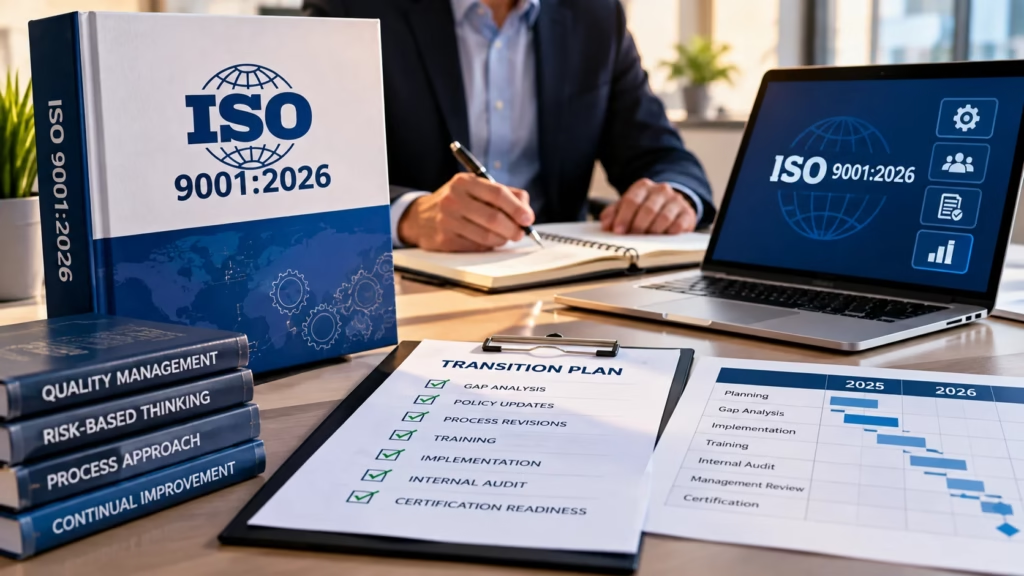
ISO 9001:2026 Is Here: What Changes and Your Transition Plan
ISO 9001:2026 is officially here.
Published on September 16, 2026, the new edition of ISO 9001 replaces ISO 9001:2015 and updates the world’s most widely used quality management system standard. The revision is designed to improve clarity, strengthen the connection between quality management and business strategy, and help organizations respond more effectively to changing risks, opportunities, and customer expectations.
For organizations currently certified to ISO 9001:2015, the change does not mean starting a quality management system from scratch.
Instead, ISO 9001:2026 is intended as an evolution of the existing framework. Organizations should assess their current QMS, identify the areas affected by the revision, and make targeted changes before completing their transition.
What Is ISO 9001:2026?
ISO 9001:2026 is the sixth edition of the ISO 9001 quality management systems standard.
It provides requirements for organizations to establish, implement, maintain, and continually improve a quality management system.
The standard continues to focus on fundamental concepts such as:
- Customer focus
- Leadership
- Process-based management
- Risk-based thinking
- Continual improvement
- Evidence-based decision-making
- Relationship management
The 2026 revision maintains this familiar foundation while updating the standard to better reflect modern business environments, including increasingly complex supply chains, digitalization, resilience, and changing customer expectations.
What Has Changed in ISO 9001:2026?
The 2026 revision introduces targeted changes rather than a complete restructuring of the standard.
The major areas of emphasis include leadership, quality culture, strategic alignment, risks and opportunities, people, and clearer guidance on how the requirements should be interpreted.
1. Stronger Emphasis on Leadership
Leadership has always been an important part of ISO 9001.
ISO 9001:2026 strengthens this expectation by placing greater emphasis on leadership’s role in creating a culture of quality and ethical behaviour.
Organizations should be able to demonstrate that quality is not simply the responsibility of the quality department.
Top management should actively support the effectiveness of the QMS and create an environment in which employees understand their role in achieving quality objectives.
This means organizations may need to look beyond documented policies and demonstrate how leadership actually influences quality performance.
2. Quality Culture and Ethical Behaviour
The new edition places greater emphasis on the organization’s quality culture.
Employees should understand why quality matters and how their actions can affect the effectiveness of the QMS.
Organizations should consider whether employees:
- Understand quality objectives
- Understand their responsibilities
- Recognize the importance of quality
- Understand relevant ethical expectations
- Have appropriate awareness of how their work affects customers and organizational performance
This is particularly important because a quality management system can have strong procedures on paper while still failing to produce consistent results in practice.
3. Stronger Connection Between Quality and Business Strategy
ISO 9001:2026 strengthens the connection between the QMS and the organization’s strategic direction.
The quality policy is more explicitly connected with the organization’s context and strategic direction.
This reinforces the idea that a QMS should not operate as a separate compliance program.
Instead, quality management should support business objectives.
Organizations should therefore consider whether their:
Business strategy → Quality objectives → Processes → Resources → Performance measures
are properly aligned.
If quality objectives have no meaningful connection to business priorities, the organization may be missing one of the key opportunities created by the new edition.
4. Clearer Treatment of Risks and Opportunities
ISO 9001:2026 provides greater clarity around risks and opportunities.
The revised standard distinguishes more clearly between managing risks and pursuing opportunities.
The goal is to encourage organizations to take proactive action rather than simply reacting to problems after they occur.
Organizations should review how they identify and evaluate:
- Business risks
- Operational risks
- Customer-related risks
- Supply-chain risks
- Process risks
- Compliance risks
- Opportunities for improvement
- Opportunities for better performance
The focus should be on making risk and opportunity information useful for decision-making.
5. Greater Emphasis on People
ISO 9001:2026 adds greater emphasis to people’s awareness and contribution to the QMS.
Quality depends on more than documented procedures and technology.
Employees need to understand how their work contributes to quality and why their actions matter.
Organizations should review whether training and awareness programs effectively communicate:
- Quality objectives
- Individual responsibilities
- Quality culture
- Ethical behaviour
- Process performance
- The consequences of failing to meet requirements
This may require organizations to strengthen existing awareness and competency programs.
6. New Annex A for Greater Clarity
One of the notable additions in ISO 9001:2026 is a new Annex A designed to help users better understand important concepts, terminology, and the intent behind the requirements.
The purpose is to make the standard easier to interpret and apply consistently.
This can be particularly useful when organizations are conducting internal audits, preparing procedures, or evaluating whether existing processes meet the revised requirements.
7. The Harmonized Structure Remains
Organizations already using ISO management system standards should find the overall structure familiar.
ISO 9001:2026 retains the Harmonized Structure used across ISO management system standards.
This means organizations with integrated systems involving standards such as ISO 14001 or ISO 45001 can continue using an integrated management-system approach.
What Has Not Changed?
One of the most important points about ISO 9001:2026 is what remains the same.
The revision does not replace the fundamental quality management approach.
Customer focus, the process approach, risk-based thinking, and continual improvement remain central to the standard.
Organizations therefore do not need to rebuild their QMS from the ground up.
Existing processes that are working effectively should generally be retained.
The transition should focus on identifying where the revised requirements create a need for improvement.
Does ISO 9001:2026 Require a Completely New QMS?
No.
ISO specifically states that organizations should build on their existing systems and processes rather than completely changing their QMS.
The practical approach is:
Keep what works → Identify the changes → Perform a gap assessment → Update affected processes → Implement → Verify effectiveness
This approach can reduce unnecessary disruption while still addressing the revised requirements.
Your ISO 9001:2026 Transition Plan
Organizations certified to ISO 9001:2015 should begin with a structured transition plan.
Step 1: Understand the New Requirements
Start by reviewing ISO 9001:2026 and identifying the requirements that have changed or been clarified.
Pay particular attention to:
- Leadership
- Quality culture
- Ethical behaviour
- Strategic alignment
- Risks and opportunities
- People and awareness
- Annex A
- Changes affecting your existing QMS processes
The objective is not simply to create a list of new requirements.
The organization should understand how those requirements affect the way the QMS currently operates.
Step 2: Perform a Gap Assessment
Conduct a formal gap assessment between your existing ISO 9001:2015 QMS and ISO 9001:2026.
Review:
- Policies
- Procedures
- Work instructions
- Quality objectives
- Risk assessments
- Management reviews
- Internal audits
- Training
- Competency
- Corrective actions
- Performance monitoring
- Supplier controls
- Continual improvement activities
Classify each area as:
Compliant → Needs clarification → Needs modification → New action required
This creates a practical roadmap for the transition.
Step 3: Review Your Quality Policy and Objectives
Because ISO 9001:2026 strengthens the relationship between quality and organizational strategy, review your quality policy and objectives.
Ask:
- Do our quality objectives support our business strategy?
- Are objectives measurable?
- Does management actively review performance?
- Are quality objectives understood throughout the organization?
- Do our metrics measure what actually matters to customers and the business?
If quality objectives exist only because ISO requires them, the transition is an opportunity to make them more meaningful.
Step 4: Review Risk and Opportunity Processes
Evaluate your existing risk-based approach.
Determine whether the organization:
- Identifies relevant risks
- Identifies opportunities
- Evaluates their significance
- Assigns appropriate actions
- Tracks those actions
- Reviews effectiveness
- Uses risk information during decision-making
Risk management should not exist as an isolated spreadsheet.
It should connect with business planning, operations, suppliers, customer requirements, changes, and improvement activities.
Step 5: Strengthen Employee Awareness
Review training and awareness programs.
Employees should understand not only what procedure they must follow, but also why the procedure matters.
Consider updating:
- Training materials
- Employee orientation
- Quality awareness programs
- Competency assessments
- Job responsibilities
- Internal communications
Management should also communicate the organization’s expectations regarding quality culture and ethical behaviour.
Step 6: Update Documentation Where Necessary
Do not automatically rewrite every QMS document.
Instead, identify documents affected by the new requirements.
Potential updates may include:
- Quality manual or QMS overview
- Quality policy
- Risk-management procedures
- Training procedures
- Management review procedures
- Internal audit procedures
- Strategic planning processes
- Quality objectives
- Awareness and communication processes
The goal should be a controlled and useful QMS, not more paperwork.
Step 7: Train Management and Employees
Once changes are identified, provide appropriate training.
Different groups may require different levels of training.
Top Management
Focus on:
- Strategic alignment
- Quality culture
- Leadership responsibilities
- Risks and opportunities
- QMS performance
Quality Team
Focus on:
- Revised requirements
- Gap closure
- Internal audits
- Documentation
- Risk and opportunity evaluation
Employees
Focus on:
- Awareness
- Responsibilities
- Quality objectives
- Process requirements
- Quality culture
Step 8: Conduct an Internal Audit
Before the transition audit, conduct an internal audit against ISO 9001:2026.
The audit should evaluate not only whether procedures have been updated, but whether the revised processes are actually implemented and effective.
Auditors should look for objective evidence.
For example:
Procedure → Employee implementation → Records → Performance data → Improvement
The evidence should demonstrate that the QMS is functioning rather than simply documenting compliance.
Step 9: Conduct Management Review
Management should review the transition status and determine whether the QMS is ready.
The review should consider:
- Gap-assessment results
- Internal audit findings
- Corrective actions
- Quality objectives
- Risks and opportunities
- Resource requirements
- Employee awareness
- QMS performance
- Remaining transition activities
Any unresolved issues should have clear ownership and timelines.
Step 10: Coordinate With Your Certification Body
If your organization is already certified to ISO 9001:2015, contact your certification body to understand its transition process.
Organizations certified to ISO 9001:2015 have until September 30, 2029 to complete the transition to ISO 9001:2026. The transition may occur during a scheduled surveillance or recertification audit, or through a separate transition audit.
Certification bodies themselves are also working through the accreditation transition.
According to ISO’s transition guidance:
- Accreditation bodies should be ready to assess ISO 9001:2026 by March 31, 2027.
- Accredited certification bodies must submit transition declarations by June 30, 2027.
- Accreditation-body transition decisions are scheduled to be completed by September 30, 2027.
- From March 31, 2028, new and initial accredited certifications may only be issued to ISO 9001:2026.
- Existing ISO 9001:2015 certifications must transition by September 30, 2029.
Organizations should confirm the specific audit arrangements and dates with their certification body.
A Practical Transition Timeline
A structured transition could look like this:
Phase 1 — Initial Review
Now
- Obtain ISO 9001:2026
- Understand the changes
- Identify affected processes
- Assign transition responsibilities
Phase 2 — Gap Assessment
Next
- Compare ISO 9001:2015 and ISO 9001:2026
- Identify gaps
- Prioritize high-impact changes
- Develop an action plan
Phase 3 — Implementation
- Update affected processes
- Update documentation
- Strengthen risk and opportunity processes
- Improve quality awareness
- Train employees
Phase 4 — Verification
- Conduct internal audits
- Evaluate implementation
- Close findings
- Conduct management review
Phase 5 — Certification Transition
- Coordinate with the certification body
- Schedule the transition audit
- Address audit findings
- Complete transition before the applicable deadline
Common Transition Mistakes to Avoid
Organizations can make the transition more difficult by treating ISO 9001:2026 as a documentation project.
Common mistakes include:
Rewriting Everything
Not every procedure needs to change.
Focus on requirements and processes actually affected by the revision.
Waiting Until the Last Minute
Although the transition deadline is September 30, 2029, organizations should not assume that waiting until the final year is the best strategy.
Early assessment gives companies time to implement changes and verify effectiveness.
Treating Quality as the Quality Department’s Responsibility
The revised standard reinforces leadership and quality culture.
Management and employees across the organization need to understand their role in QMS effectiveness.
Treating Risk as a Checklist
Risk and opportunity management should support actual decision-making rather than exist only as documentation.
Ignoring Existing Strengths
ISO 9001:2026 is an evolution of the existing framework.
Organizations should preserve processes that work and improve areas where the new edition creates additional value.
ISO 9001:2026 Transition Checklist
Before completing your transition, consider whether you have:
☐ Reviewed ISO 9001:2026
☐ Completed a gap assessment
☐ Reviewed the quality policy
☐ Reviewed quality objectives
☐ Evaluated leadership responsibilities
☐ Reviewed quality culture and ethical behaviour
☐ Evaluated risks and opportunities
☐ Reviewed employee awareness and competency
☐ Updated affected QMS documentation
☐ Trained relevant employees
☐ Completed an ISO 9001:2026 internal audit
☐ Addressed internal audit findings
☐ Completed management review
☐ Confirmed transition arrangements with the certification body
☐ Scheduled the certification transition audit
The Bottom Line
ISO 9001:2026 is now the current edition of the international quality management system standard.
The revision does not require organizations to abandon their existing QMS. Instead, it strengthens and clarifies important areas including leadership, quality culture, strategic alignment, risks and opportunities, people, and the practical interpretation of requirements.
For organizations certified to ISO 9001:2015, the transition deadline is September 30, 2029.
The most effective approach is to start with a gap assessment, prioritize the areas that genuinely need improvement, involve leadership and employees, and verify that changes are working before the certification transition audit.
The transition should be more than an effort to maintain a certificate.
Used effectively, ISO 9001:2026 provides an opportunity to strengthen the connection between quality, business strategy, risk management, employee engagement, and long-term performance.
Need Help With Your ISO 9001:2026 Transition?
JJCC Group can help organizations assess their existing quality management systems, identify gaps against ISO 9001:2026, update affected processes, prepare employees, and build a practical transition plan.
If your organization is currently certified to ISO 9001:2015, now is the time to understand what the new edition means for your QMS and begin planning the transition.
