



Top Part 111 Form 483 Observations and How to Prevent Them
FDA inspections of dietary supplement manufacturers continue to identify recurring deficiencies under 21 CFR Part 111, the Current Good Manufacturing Practice (CGMP) requirements for dietary supplements.
A Form FDA 483 is issued when an FDA investigator observes conditions or practices that, in the investigator’s judgment, may indicate violations of FDA requirements. A Form 483 is not a final agency determination, but the observations can become the basis for further regulatory action if the underlying issues are not adequately addressed.
Recent FDA enforcement activity shows that many Part 111 problems are not caused by a single isolated mistake. They often involve gaps across the quality system, including specifications, manufacturing records, sanitation, quality control, investigations, and documentation.
Understanding these recurring observations can help dietary supplement manufacturers prepare for FDA inspections and identify weaknesses before they become inspection findings.
What Is an FDA Form 483?
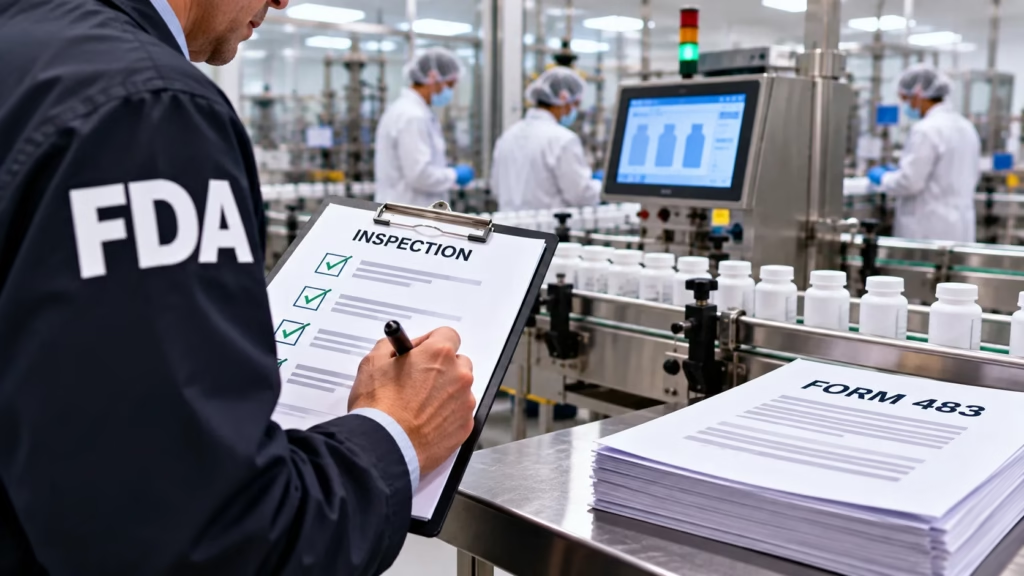
An FDA Form 483, Inspectional Observations, communicates objectionable conditions observed during an FDA inspection.
Investigators issue observations based on what they see and document during the inspection. FDA explains that a Form 483 is not an all-inclusive list of every possible deficiency at a facility. A company remains responsible for addressing both cited observations and related problems that may not have been included on the form.
For dietary supplement manufacturers, observations can involve requirements throughout 21 CFR Part 111, from personnel and quality control to production, specifications, laboratory controls, records, and complaint handling.
1. Inadequate Finished Product Specifications
One of the recurring Part 111 findings involves failure to establish adequate specifications for finished dietary supplements.
Under 21 CFR 111.70(e), manufacturers must establish specifications for the identity, purity, strength, and composition of finished batches, as well as appropriate limits on contaminants that could adulterate the product.
Recent FDA enforcement actions have identified failures involving missing or incomplete specifications for identity, purity, strength, and composition.
Why This Becomes a 483 Observation
A specification sheet may exist, but that does not necessarily mean it satisfies Part 111.
For example, FDA has identified situations where companies provided strength information but lacked adequate methodology or specifications for identity and purity. FDA has also identified inconsistencies between product specifications and label claims.
How to Prevent It
Manufacturers should review each finished product specification and confirm that it addresses, as applicable:
- Identity
- Purity
- Strength
- Composition
- Contaminant limits
- Appropriate test methods
- Acceptance criteria
- Relevant label claims
Specifications should be product-specific and supported by appropriate scientific and manufacturing considerations.
2. Incomplete Master Manufacturing Records
The Master Manufacturing Record (MMR) is another area where FDA investigators may identify significant deficiencies.
Under 21 CFR 111.210, the MMR must contain the information necessary to ensure that the dietary supplement is consistently manufactured according to established specifications.
Recent FDA enforcement has identified MMRs that were missing required manufacturing instructions and theoretical-yield information.
Common MMR Problems
Examples can include missing:
- Manufacturing instructions
- Required process controls
- Theoretical yields
- Appropriate yield limits
- Specifications
- Equipment identification
- Packaging and labeling instructions
- Required verification steps
How to Prevent It
Conduct an MMR-by-MMR review against 21 CFR 111.210.
Do not assume that an old MMR template automatically contains every required element.
Each MMR should be controlled, approved, current, and consistent with the actual manufacturing process.
3. Incomplete Batch Production Records
Batch Production Records (BPRs) provide evidence of what actually happened during manufacturing.
FDA has recently identified BPR deficiencies involving missing information such as equipment identification, cleaning and maintenance information, actual yields, and actual monitoring results.
Why BPRs Matter
An MMR describes what should happen.
The BPR demonstrates what actually happened.
If the BPR does not contain required information, FDA may have difficulty determining whether the batch was manufactured according to the approved process.
How to Prevent It
Before releasing a batch, QA should verify that the BPR includes all required information, including where applicable:
- Equipment and processing-line identification
- Dates and times of required activities
- Cleaning and sanitizing information
- Actual yields
- Percentage of theoretical yield
- Actual monitoring results
- Required signatures or verification
- Deviations and investigations
- Material disposition decisions
A strong BPR review process should identify missing information before the batch is released.
4. Poor Sanitation and Contamination Controls
Sanitation remains a major inspection concern for dietary supplement manufacturers.
Under Part 111, manufacturing operations must be conducted in accordance with adequate sanitation principles, and manufacturers must take necessary precautions to prevent contamination.
Recent FDA findings have included:
- Product residue accumulating on equipment
- Poorly maintained equipment surfaces
- Inadequate cleaning
- Improper employee hygiene
- Inaccessible handwashing facilities
- Employees contacting exposed product
- Potential cross-contamination concerns
How to Prevent It
Facilities should maintain effective:
- Cleaning and sanitation SOPs
- Master sanitation schedules
- Pre-operational inspections
- Equipment cleaning records
- Employee hygiene procedures
- Gowning requirements
- Handwashing procedures
- Pest-control programs
- Cross-contamination controls
The important point is that having a sanitation SOP is not enough.
FDA investigators can observe whether employees actually follow it and whether the facility conditions demonstrate that the controls are effective.
5. Inadequate Equipment Design or Maintenance
Equipment and utensils must be maintained in a condition that prevents contamination and allows effective cleaning.
FDA has cited equipment with seams or surfaces that allowed accumulation of dietary supplement residue and other materials.
This can become particularly significant when equipment is shared between products.
How to Prevent It
Manufacturers should inspect equipment for:
- Cracks
- Damaged surfaces
- Poorly bonded seams
- Product buildup
- Difficult-to-clean areas
- Corrosion
- Residue accumulation
Preventive maintenance should address both equipment functionality and sanitary design.
Cleaning verification should also demonstrate that the cleaning procedure actually works.
6. Quality Control Personnel Are Not Properly Qualified
Part 111 places specific responsibilities on the quality control unit.
Recent FDA enforcement in 2026 identified a facility where individuals performing quality control responsibilities were not adequately qualified for those responsibilities.
Why This Matters
Having someone designated as “Quality” does not automatically demonstrate that the individual is qualified to perform required QC functions.
Manufacturers should be able to demonstrate that QC personnel have appropriate:
- Education
- Training
- Experience
- Knowledge of applicable requirements
- Understanding of the company’s procedures
- Understanding of their assigned responsibilities
How to Prevent It
Maintain a documented qualification matrix for QC personnel.
Training records should demonstrate not only that training occurred, but also that employees are competent to perform their assigned responsibilities.
7. Weak Material Review and Disposition Documentation
When a material or product does not meet requirements, the company needs a documented process for investigation, review, and disposition.
FDA has cited failures to document material review and disposition decisions, including situations where quality personnel were aware of out-of-specification or other problematic results but did not adequately document the investigation and disposition.
How to Prevent It
Establish a controlled process for:
Problem identified → Material placed on hold → Investigation → Quality review → Disposition decision → Documentation → Follow-up
The record should explain what happened, what was investigated, who reviewed the issue, and why the final disposition was appropriate.
8. Inadequate Complaint Handling
Complaints can provide important information about product quality and potential health hazards.
Manufacturers should have procedures for receiving, evaluating, investigating, documenting, and appropriately escalating complaints.
FDA’s recent enforcement activity has identified deficiencies involving complaint procedures and related evaluations.
How to Prevent It
Complaint procedures should clearly define:
- Who receives complaints
- How complaints are documented
- When an investigation is required
- How product quality is evaluated
- When a health hazard evaluation is necessary
- How potential adverse events are evaluated
- When escalation is required
- How complaint trends are reviewed
A complaint database should also support meaningful trend analysis.
9. Inadequate Recordkeeping
Documentation problems can turn an otherwise manageable issue into a significant inspection observation.
FDA expects manufacturers to maintain records demonstrating compliance with applicable Part 111 requirements.
Common documentation weaknesses include:
- Missing records
- Incomplete records
- Undated entries
- Missing signatures
- Inconsistent information
- Records that do not match actual practices
- Failure to document investigations
- Failure to retain supporting evidence
How to Prevent It
Companies should conduct routine record reviews rather than waiting for an FDA inspection.
QA should verify that critical records are:
- Complete
- Accurate
- Legible
- Traceable
- Timely
- Properly approved
- Consistent with related records
10. Corrective Actions That Do Not Address the Root Cause
Responding to a Form 483 with a quick correction is not always enough.
FDA may evaluate whether the company’s corrective action actually addresses the underlying problem.
For example, if an investigator observes poor cleaning, simply cleaning the equipment after the inspection may not demonstrate that the systemic problem has been corrected.
A stronger response could involve:
Immediate correction → Root-cause investigation → CAPA → Procedure update → Training → Implementation evidence → Effectiveness verification
Recent FDA enforcement demonstrates the importance of providing objective evidence that corrective actions were actually implemented. In one 2026 case, FDA stated that it could not evaluate the adequacy of proposed corrective actions because the firm had not provided supporting implementation evidence such as logs, photos, work orders, verification records, and training records.
11. Label and Specification Inconsistencies
FDA may compare product labels against specifications and manufacturing records.
If a product label makes a claim that is not reflected in the corresponding specifications or testing
